
Constipation and Bowel Leakage
Why You Can Feel Blocked Up and Still Have Accidents
Many people are surprised to learn that constipation and bowel leakage, also known as faecal incontinence, often occur together.
You might feel "blocked up" and still have accidents. Or you might be told your stool is "too loose" even though you do not feel properly empty. Both can be true at the same time.
The cause is often incomplete emptying of the rectum, sometimes combined with pelvic floor dysfunction, reduced sensation, or difficulty controlling loose stool.
The central question is not simply:
"Why am I leaking?"
It is:
"Am I failing to empty, failing to hold, or both?"
That distinction matters because the right treatment depends on the right problem.
In Short
Constipation with bowel leakage is often not just a problem of stool being "too hard" or "too loose".
In many people, the rectum does not empty properly. Stool stays behind, the rectum becomes stretched and less sensitive, and softer stool may leak around what is retained.
In others, the rectum may empty reasonably well, but the anal sphincter or pelvic floor cannot reliably hold softer stool.
And in many people, both problems overlap.
Treatment works best when we separate the two goals:
- Emptying: clearing the rectum properly and predictably
- Holding: keeping stool formed and controllable between bowel motions
Why Constipation and Bowel Leakage Often Happen Together
Several mechanisms can overlap:
- Incomplete emptying, with stool remaining in the rectum
- Rectal stretching and reduced sensation, causing a weaker or delayed urge
- Softer stool leaking around retained stool
- Weakness of the anal sphincter or pelvic floor muscles
- Pelvic floor muscles that do not relax properly during bowel movements
This is why someone can be constipated and still have bowel accidents.
Many people describe the cycle as:
"Blocked, then leaking — or loose and leaking — but never really in control."
Why Softening Stool Alone Can Make Things Worse
Fibre and laxatives are often helpful in straightforward constipation. However, when bowel leakage is also present, simply softening the stool can sometimes backfire.
There are two common situations.
Incomplete Emptying
The rectum does not empty properly. Stool remains behind, and when it is softened it can leak around what is retained.
Reduced Control
The rectum may empty reasonably well, but the anal sphincter is not strong enough to reliably hold softer or looser stool.
In both situations, softening the stool does not address the underlying problem. Instead, it may:
- Make stool harder to hold in
- Increase leakage
- Make bowel function less predictable
This does not mean fibre or laxatives are bad. It means they need to be used for the right problem and in the right way.
This is one reason why bowel leakage should not automatically be assumed to be a problem of weak muscles or poor control.
Sometimes the leakage develops because the stool has become too loose to hold comfortably.
For example, a person with chronic constipation may be prescribed increasing doses of laxatives. The constipation improves, but the resulting loose stool becomes harder to control, particularly if there is already mild sphincter weakness, impaired sensation, pelvic floor dysfunction or advancing age.
Similarly, bowel leakage may improve substantially when conditions such as bile acid diarrhoea, microscopic colitis, inflammatory bowel disease, medication-related diarrhoea, overflow from constipation or pelvic floor dysfunction are recognised and treated appropriately.
In these situations, the solution may not be stronger continence treatments. It may be understanding the underlying bowel problem more accurately and finding the right balance between emptying and control.
The Role of Pelvic Floor Dysfunction
In many people with constipation and bowel leakage, the pelvic floor muscles do not coordinate properly during bowel movements. This is called pelvic floor dysfunction or dyssynergic defecation.
Normally, the pelvic floor should relax when you open your bowels. In some people, these muscles tighten instead, or fail to relax properly. This makes it difficult to empty the rectum completely, even when the urge is strong.
The result may be:
- Ongoing constipation
- A sensation of incomplete emptying
- Straining
- Repeated trips to the toilet
- Leakage caused by retained stool
How Is Pelvic Floor Dysfunction Diagnosed?
Specialised anorectal physiology testing can help identify pelvic floor dysfunction.
Tests may include:
- Anorectal manometry: measuring pressures in the rectum and anal canal
- Balloon expulsion testing: assessing how effectively the rectum can empty
- Assessment of rectal sensation and coordination
These tests help determine whether leakage is partly due to an emptying problem rather than only a holding problem.
Treatment: Pelvic Floor Physiotherapy and Biofeedback
Pelvic floor physiotherapy with biofeedback is often the most effective treatment for pelvic floor dysfunction.
It aims to teach patients how to:
- Relax the pelvic floor during bowel movements
- Coordinate pushing and relaxation
- Improve toilet posture and breathing
- Improve rectal sensation where needed
For some people, improving pelvic floor function is enough to avoid more invasive treatments.
What You Can Do While Waiting for Specialist Help
Waiting times for specialist pelvic floor physiotherapy and biofeedback can sometimes be many months, and occasionally more than a year.
While waiting, simple measures may help.
Use the Gastrocolonic Reflex
The bowel is naturally more active after eating, especially after breakfast or a larger meal.
Try:
- Sitting on the toilet 15–30 minutes after breakfast
- Allowing 5–10 minutes of unhurried time
- Avoiding straining
- Using good posture
Optimise Toilet Position
Many people empty better when:
- Feet are supported on a small footstool
- Knees are slightly higher than hips
- They lean forward slightly
- They avoid prolonged straining
Practise Relaxed Breathing
Slow diaphragmatic, or "belly", breathing can help reduce pelvic floor tension and improve coordination during bowel movements.
A Different Way to Think About Treatment
For many people, trying to make the bowel work perfectly every day is not realistic.
Instead, treatment is often more successful when we separate the plan into two parts.
Step 1: Empty Properly and Predictably
Rather than relying on unpredictable urges, some patients benefit from a structured approach to emptying the rectum.
This may involve:
- A regular toilet routine
- Suppositories
- Micro-enemas
- Pelvic floor retraining
- Transanal irrigation in selected patients
The aim is to:
- Clear retained stool
- Reduce incomplete emptying
- Improve predictability
- Reduce leakage between bowel motions
Step 2: Keep Stool Controllable in Between
Once rectal emptying is improved, the focus often shifts to improving control between bowel motions.
Depending on the person, this may involve:
- Reducing excessive laxative use
- Small doses of loperamide
- Cholestyramine if bile acid diarrhoea is contributing
- Moderate rather than excessive fibre intake
The aim is not to cause constipation.
The aim is to produce stool that is formed enough to hold comfortably and predictably.
Putting It Together
The strategy is simple:
- Empty properly and predictably
- Treat pelvic floor dysfunction if present
- Keep stool calm and controllable in between
The goal is not perfect bowels.
The goal is fewer accidents, less time managing bowels, and more confidence in daily life.
When Conservative Measures Aren’t Enough: The Next Steps
Once the main problem has been identified, treatment becomes easier to understand.
Most advanced treatments are aimed primarily at either:
- Improving emptying
- Improving holding
- Creating predictability when neither can be restored well enough
The question remains:
Is the main problem emptying, holding, or both?
Before Considering Procedures
Before moving to procedures such as transanal irrigation or sacral nerve stimulation, it is important to ensure pelvic floor dysfunction has been considered and treated where appropriate.
Many patients benefit from anorectal physiology testing and pelvic floor physiotherapy before more invasive options are explored.
This is especially important when symptoms include:
- Straining
- Incomplete emptying
- Rectal loading
- Repeated trips to the toilet
- Leakage after feeling incompletely emptied
Option 1: Transanal Irrigation
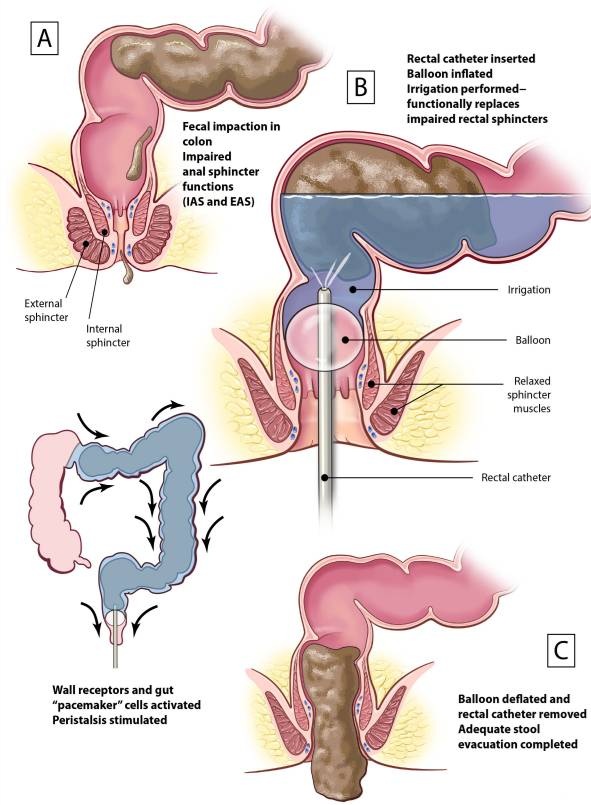
Transanal irrigation, or TAI, is generally considered when the dominant problem is incomplete emptying with secondary leakage.
TAI helps people empty.
The principle is simple: rather than relying on unreliable urges, the bowel is emptied deliberately and predictably using water introduced through the rectum.
TAI may be considered when there is:
- Incomplete rectal emptying
- Overflow leakage
- Mixed constipation and faecal incontinence
- Failure of simpler measures
What Is TAI Trying to Achieve?
For many people, the problem is not that stool reaches the rectum too quickly.
The problem is that stool never fully leaves.
Retained stool stretches the rectum, reduces sensation and creates a reservoir from which leakage can occur.
TAI aims to:
- Empty the rectum more completely
- Reduce stool retention
- Reduce overflow leakage
- Create more predictable bowel function
Does TAI Work?
TAI can be very effective in the right patient.
However, it is important to be realistic.
TAI requires training, time, equipment and ongoing commitment. Some people find it life-changing. Many others decide it is not for them, or discontinue it over time.
Success depends as much on motivation, support and practicality as it does on bowel physiology.
For this reason, TAI is best viewed as a useful option for selected patients, not a universal solution.
Is TAI Safe?
TAI is generally safe when introduced by experienced clinicians with appropriate training and follow-up.
Common side effects include:
- Abdominal cramping
- Temporary discomfort
- Minor local irritation
Serious complications, such as bowel perforation, are very rare.
TAI is not suitable for everyone. Your specialist will determine whether it is safe and appropriate for your situation.
The Practical Message About TAI
TAI is not a first-line treatment and not a shortcut.
It is usually considered after:
- Diet and medication optimisation
- Pelvic floor physiotherapy
- Biofeedback where appropriate
- Suppositories or micro-enemas
For people whose main problem is incomplete emptying, it can sometimes provide a degree of predictability that simpler treatments cannot achieve.
The goal is not perfect bowels.
The goal is fewer accidents, better predictability and greater confidence.
Option 2: Sacral Nerve Stimulation
Sacral nerve stimulation, or SNS, is designed for a different problem.
TAI helps people empty.
SNS helps people hold.
SNS is most appropriate when:
- The bowel empties reasonably well
- The dominant problem is urgency or incontinence
- Stool consistency can be reasonably controlled
- A temporary test stimulation produces clear improvement
A small electrical stimulator is implanted to influence the nerves that help regulate bowel function.
Exactly how SNS works is not fully understood. It appears to improve communication between the bowel, pelvic floor and nervous system, helping restore better sensation, timing and control.
Does SNS Work?
SNS helps many carefully selected patients with faecal incontinence.
However:
- Not everyone responds
- Benefit can diminish over time
- Further procedures are sometimes required
- Device-related complications can occur
For these reasons, SNS should be viewed as an effective option for selected patients rather than a guaranteed solution.
When Might SNS Be Less Helpful?
SNS is less likely to help when:
- The dominant problem is incomplete emptying
- Significant retained stool remains in the rectum
- Severe evacuation disorders are present
- Diarrhoea remains uncontrolled
In short, SNS improves control.
It does not mechanically empty the bowel.
Option 3: When a Stoma Is Considered
A stoma is generally considered when symptoms remain severe despite appropriate treatment.
This may occur when:
- Emptying and continence problems are both severe
- TAI and SNS have failed, are unsuitable, or are unlikely to solve the main problem
- Quality of life remains significantly impaired
- Reliability and predictability have become more important than preserving normal bowel anatomy
A stoma is not a failure.
It is a deliberate decision to prioritise control, dignity and quality of life when the bowel can no longer be made predictable enough.
What Does the Evidence Show?
Studies consistently report high satisfaction rates among people who choose a stoma for severe bowel dysfunction. Many describe substantial improvements in confidence, independence, social functioning and overall quality of life.
Satisfaction appears to be highest when the dominant problem is severe faecal incontinence, particularly when leakage is unpredictable, socially disabling and has not improved with other treatments.
People with neurological bowel dysfunction may also report high satisfaction when a stoma reduces prolonged bowel care, dependence on carers, leakage, skin complications and the amount of time spent managing their bowels each day. This includes conditions such as spinal cord injury, multiple sclerosis and other neurological disorders that affect bowel control.
For some people, bowel care can take 45–120 minutes, require assistance from another person, and force daily life to be planned around bowel routines. In that context, a stoma may offer not just continence, but time, privacy and predictability.
Outcomes are often more mixed when the main problem is severe constipation, particularly when there is widespread slow bowel transit or diffuse colonic dysfunction. In that situation, a stoma may not resolve all symptoms and may create new challenges of its own.
Many people who choose a stoma later say:
"I wanted predictability more than normal."
and
"I wish I had done this earlier."
For some, it becomes the most effective treatment they have ever received.
Important to Understand
A stoma can be life-changing, but it is not a simple solution.
Living with a stoma involves:
- Ongoing stoma care
- Changes to daily routines
- Adjustment to a different body image
- The possibility of stoma-related complications
- Occasionally, the need for further surgery
The goal is not to create a perfect bowel.
The goal is to replace unpredictable and life-limiting bowel dysfunction with a more reliable and manageable situation.
When Should a Stoma Be Discussed Earlier?
In some situations, it may be kinder and more realistic to discuss a stoma earlier rather than working through every possible intermediate treatment.
This may include people with:
- Severe faecal incontinence where predictability matters more than preserving normal anatomy
- Neurological bowel dysfunction with prolonged, unreliable bowel care
- Severe combined emptying and continence problems
- Major structural damage to the anorectum
- Symptoms that remain disabling despite appropriate conservative treatment
- A clear preference for reliability over ongoing trial-and-error treatment
This does not mean a stoma is the only option. It means it should be part of an honest discussion.
The Real Message
A stoma should not be considered prematurely.
However, it should not be viewed as a failure or only as a last desperate option.
For carefully selected people whose lives are dominated by bowel dysfunction, a stoma can restore freedom, confidence and dignity when other treatments have not been enough.
The decision is highly individual and should be made only after careful discussion with your specialist team.
The Short Version
- Pelvic floor dysfunction should be considered early and treated when present.
- TAI helps people empty.
- SNS helps people hold.
- A stoma provides predictability when other treatments cannot.
The best treatment depends on understanding how your bowel is failing, not simply how often leakage occurs.
When You Should Seek Medical Advice
You should seek medical review if you develop:
- New or worsening bowel leakage
- Blood in the stool
- Unexplained weight loss
- Anaemia
- Severe or persistent abdominal or rectal pain
- A major change in bowel habit
- Symptoms beginning later in life
- Neurological symptoms such as leg weakness, numbness or bladder dysfunction
A Final Word
Constipation with bowel leakage is common, distressing and often misunderstood.
In many people, the key issue is not stool consistency alone. The underlying problem is often incomplete rectal emptying, impaired pelvic floor coordination, reduced ability to control stool, or a combination of these.
The central question is:
Are we dealing with an emptying problem, a holding problem, or both?
With the right assessment and a treatment plan built around that question, symptoms can often improve substantially.