
ACNES and abdominal wall pain
Is your pain coming from your abdominal wall?
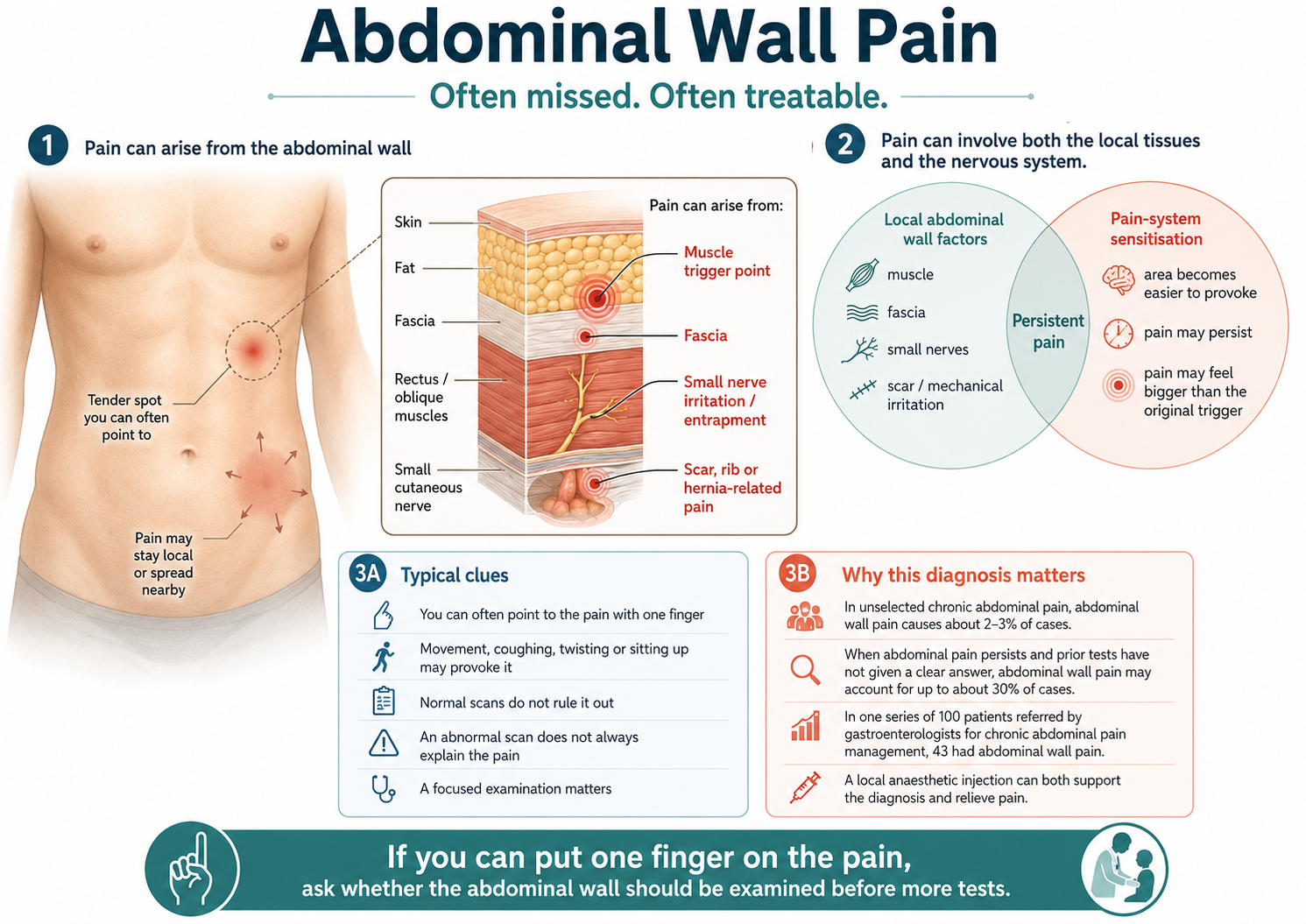
If you can point to your pain with one finger, your abdominal wall deserves to be examined.
Abdominal wall pain is common, frequently missed and often surprisingly treatable. One of its best recognised causes is anterior cutaneous nerve entrapment syndrome (ACNES), in which a small nerve becomes irritated or entrapped as it passes through the abdominal muscle and fascia.
But not all focal abdominal wall pain is ACNES. Pain can also arise from muscle and myofascial trigger points, fascia, scars, ribs, hernias or nearby nerves — and more than one mechanism may coexist.
The clue is often remarkably simple: you can identify a small area where pressing reproduces your familiar pain.
What is ACNES?
Anterior cutaneous nerve entrapment syndrome (ACNES) is a common and often overlooked cause of focal abdominal pain.
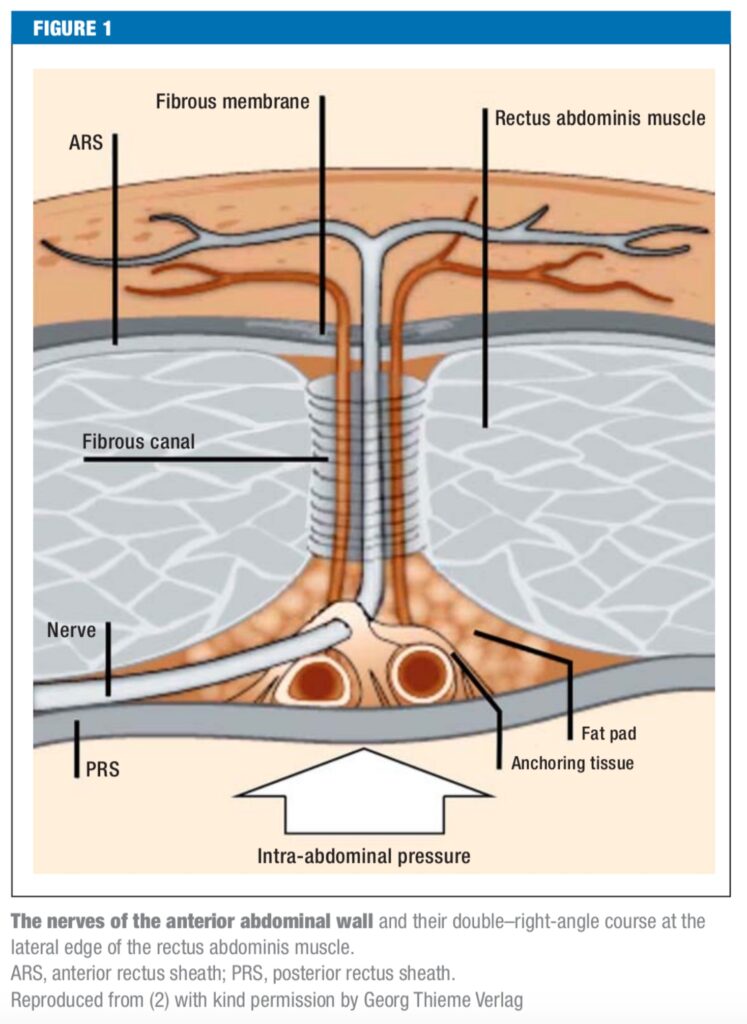
Small nerves travel around the abdominal wall and pass through the rectus abdominis — the “six-pack” muscle — before reaching the skin. Where a nerve passes through muscle and fascia it may become irritated or entrapped.
ACNES usually causes a small, very tender area of pain. It may be sharp, burning, aching or surprisingly severe, and may be made worse by movement, twisting, coughing, sitting up or certain postures.
A particularly useful clue is that you can often point to the painful spot with one finger and pressing that spot reproduces your familiar pain.
How often is abdominal wall pain missed?
The answer depends on which patients you look at.
Among unselected patients with chronic abdominal pain, abdominal wall pain accounts for about 2–3% of cases. But when pain persists and previous investigations have not found a convincing cause, studies have reported an abdominal-wall source in up to about 30% of patients.
In one series of 100 patients referred by gastroenterologists for chronic abdominal pain management, 43 had abdominal wall pain.
This helps explain a story gastroenterologists hear remarkably often: years of scans, blood tests and endoscopies, followed eventually by someone asking the patient to point to the pain and examining that exact spot.
Sometimes the most useful investigation is an examination.
Why can a local anaesthetic injection be so useful?
After identifying the precise spot that reproduces your familiar pain, a small amount of local anaesthetic can be injected into the painful abdominal-wall tissues.
If the familiar pain substantially disappears within minutes, that strongly supports an abdominal-wall pain generator. The injection can therefore provide useful diagnostic information and, for some patients, treatment at the same time.
For some people the relief lasts only as long as the anaesthetic. For others it persists much longer.
Importantly, an injection does not always tell us whether the exact source is an entrapped nerve, muscle, fascia or a combination. The first question is often simpler: is the pain actually coming from the abdominal wall?
Not all abdominal wall pain is ACNES
ACNES is an important cause of abdominal wall pain, but it is not the only one.
Pain can also arise from skeletal muscle and fascia, scars, ribs, hernias and other small nerves. Myofascial pain can produce a focal tender area where pressure reproduces the patient's familiar local or referred pain.
Muscle and nerve pain may also overlap. Pain can provoke protective muscle guarding, while persistent local pain signalling can make both the abdominal-wall tissues and the nervous system increasingly sensitive.
This is why it may be too simple to label every focal abdominal-wall pain as either “ACNES” or “muscle pain”. In some patients, the clinically useful diagnosis is a local abdominal-wall pain generator that responds to targeted treatment.
What is abdominal wall pain?
Abdominal wall pain comes from the structures of the abdominal wall itself — including small nerves, muscle, fascia, scars and connective tissue — rather than from an organ inside the abdomen.
It is common, frequently overlooked and usually treatable. Routine scans and endoscopy may be normal because nerve irritation and myofascial pain are not usually visible on conventional investigations.
Equally, finding something on a scan does not prove that it is causing the pain. Gallstones, diverticulosis, cysts and other genuine abnormalities can coexist with a separate abdominal-wall pain problem.
What can cause abdominal wall pain?
Nerves
- ACNES (anterior cutaneous nerve entrapment syndrome) — focal pain where a small cutaneous nerve passes through the abdominal muscle and fascia; often very localised and affected by movement.
- Intercostal or lateral cutaneous nerve pain — usually more lateral and sometimes wrapping around the flank or toward the back.
- Thoracic radiculopathy — pain referred into the abdomen from a thoracic nerve root.
- Scar or neuroma pain — focal nerve pain following surgery or injury.
- Post-herpetic neuralgia — persistent nerve pain after shingles, occasionally without a remembered rash.
Muscle and fascia
- Myofascial pain — a focal area within muscle or fascia where pressure reproduces the patient's familiar pain, sometimes with pain felt nearby or elsewhere.
- Rectus or oblique muscle strain.
- Persistent muscle guarding or overactivity.
- Costal-margin and slipping-rib pain.
Structural causes
- Occult or recurrent hernia, including Spigelian hernia near the rectus edge, which may cause very focal pain without a bulge and mimic ACNES.
- Abdominal-wall endometriosis, particularly near a caesarean or other surgical scar.
- Chronic pain following hernia repair or other abdominal surgery.
Why can the pain persist?
The abdominal wall contains muscle, fascia and small nerves packed closely together. Pain therefore does not always fit neatly into a single category such as “nerve pain” or “muscle pain”.
A small nerve may become irritated where it passes through muscle or fascia. Muscle may become painful after injury, repetitive loading, coughing, sport, posture or protective guarding. Surgery, scars, rib or chest-wall injury and shingles can also leave a sensitive area long after the original event.
These mechanisms can overlap. Pain may cause protective muscle tightening; painful muscle or scar tissue may irritate nearby nerves; and persistent pain signalling can make both the local tissues and the nervous system increasingly sensitive.
How is abdominal wall pain diagnosed?
The diagnosis is mainly clinical. The first step is surprisingly simple: ask the patient to point to the pain, then examine that exact spot.
Features suggesting an abdominal-wall source include a small area of reproducible tenderness and pain influenced by movement, posture, coughing, twisting or activation of the abdominal muscles.
Don’t anchor on the scan
The scan can be correct and still lead to the wrong explanation for the pain. A patient with gallstones can also have focal abdominal-wall pain; diverticulosis or a cyst may be completely incidental.
The important question is whether the abnormality actually explains the location, character and triggers of the patient's pain. Keep examining the patient, not just the investigation.
On examination
Ask the patient to point with one finger to the site of maximal pain, then examine that exact area.
- Reproduce the familiar pain — tenderness alone is not enough; ask whether pressing the spot reproduces the pain the patient actually experiences.
- Examine the muscle as well as the skin — deeper pressure through the rectus or oblique muscles may reproduce a myofascial source of pain.
- Look for sensory change — altered light touch or cold sensation and an asymmetric skin-pinch test can support a superficial nerve-related source such as ACNES.
- Test movement — sitting up, twisting, bending, coughing or changing position may reproduce the pain.
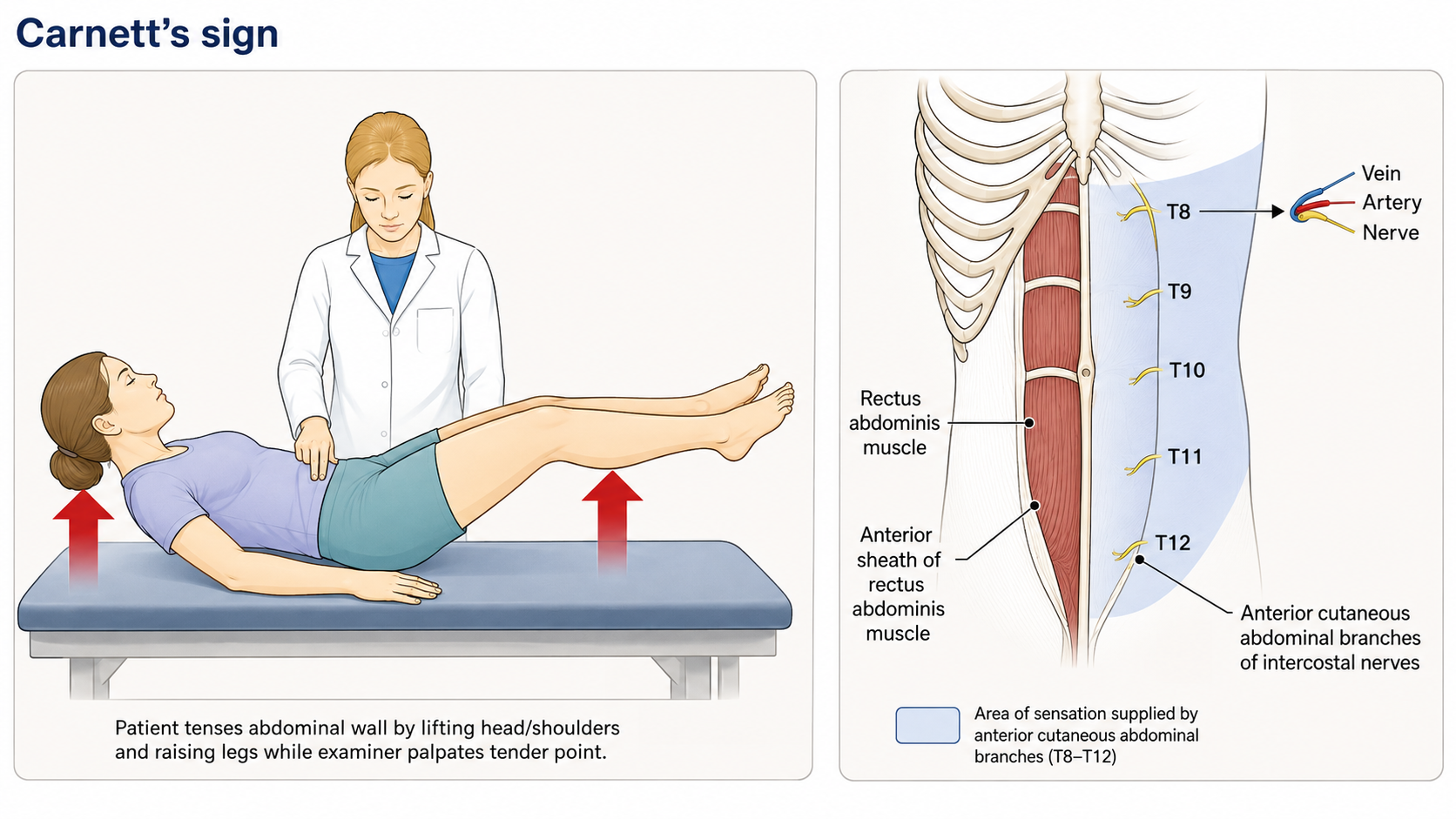
Carnett’s sign
Keep steady pressure over the point of maximal tenderness while the patient tightens the abdominal wall, for example by lifting the head and shoulders.
- Positive: tenderness remains the same or increases. This supports an abdominal-wall source.
- Negative: tenderness decreases. This makes a visceral source more important to reconsider, but does not completely exclude abdominal-wall pain.
Carnett’s sign tells us something about where the pain is behaving as though it comes from; it does not tell us whether the exact structure is a nerve, muscle, fascia or another part of the abdominal wall.
If Carnett’s sign is negative but the pain still sounds like the abdominal wall
A negative Carnett’s sign makes a superficial anterior abdominal-wall source less likely, but it does not completely exclude abdominal-wall pain.
Look again for:
- a small area where pressure reproduces the patient’s familiar pain
- altered light-touch or cold sensation, or an asymmetric skin-pinch test
- pain linked to movement, posture, coughing, twisting or changing position
- a deeper muscular or fascial source
- a lateral, costal-margin or more proximal nerve source
At the same time, reconsider visceral causes and ask whether they genuinely fit the location, character and triggers of the pain. If symptoms are intermittent, repeating the examination when the pain is present can be particularly useful.
The local anaesthetic injection
A targeted local anaesthetic injection can provide both diagnostic information and treatment.
If the patient’s familiar pain substantially improves within minutes, an abdominal-wall pain generator becomes much more likely — particularly when the history is convincing but Carnett’s sign is negative or equivocal.
The response does not necessarily tell us whether the exact structure is a small nerve, muscle, fascia or a combination. ACNES also has no single definitive diagnostic test, so the result should be interpreted together with the history and examination.
When imaging is still useful
Routine abdominal imaging may be normal in ACNES and myofascial pain. Imaging becomes more useful when there is a specific structural question about the abdominal wall.
Targeted ultrasound, dynamic ultrasound, CT or MRI may be appropriate when there is:
- a palpable lump or visible bulge
- suspected occult or recurrent hernia
- previous hernia repair or mesh
- cyclical pain around a surgical scar suggesting abdominal-wall endometriosis
- a positional bulge that appears with standing, straining or movement
- uncertainty about whether a bulge represents a true hernia or abnormal abdominal-wall movement
The aim is to image the suspected abdominal-wall problem, rather than simply repeat another routine scan of the abdomen.
Management
Treatment depends on the likely pain generator and is usually stepwise.
- Explain the diagnosis. Understanding that the pain may be coming from the abdominal wall rather than an internal organ can itself be reassuring.
- Modify provoking activities where relevant. This may include repetitive loading, particular movements, coughing or posture.
- Treat muscular or myofascial contributors. Targeted physiotherapy may help when muscle overactivity, guarding, posture or movement patterns appear important.
- Consider local injection. Local anaesthetic, sometimes with corticosteroid depending on the suspected cause, can be useful for focal abdominal-wall pain and ACNES.
- Treat neuropathic pain selectively. Medication may help some patients with a clear neuropathic component.
- Reserve procedures or surgery for selected patients. These include structural lesions such as hernias and refractory nerve entrapment that has not responded to less invasive treatment.
The key message
If you can put one finger on the pain, the abdominal wall deserves to be examined.
ACNES is one important cause, but muscle, fascia, scars, ribs, hernias and other small nerves can produce similar pain. A focused examination — and sometimes a local anaesthetic injection — may provide information that another scan or endoscopy cannot.