Colonoscopy
Prepare for your colonoscopy with your personalised plan, hospital forms, medication instructions and recovery information.
My Personal Colonoscopy Plan
Most patients use our standard preparation. A small number will need extra bowel preparation or changes to medications. Answer the questions below and we'll guide you.
Your procedure details
Please enter your procedure date.
About 45–90 minutes after admission time.
Please check your procedure time.
Most patients are told this at booking — or skip this if you've already entered your exact procedure time above.
Please choose morning or afternoon list.
Most patients can leave these two sections closed and continue with the standard Prepkit Orange pathway.
Extra bowel preparation instructions
Medication guidance for: blood thinners, diabetes pills, weight-loss injections, or other common medicines
Blood thinners
SGLT2 inhibitors / "flozins" (diabetes, heart or kidney disease)
Other diabetes meds and insulin
GLP-1 / GLP-1-GIP medicines (diabetes, weight loss)
Other common medications
Understanding your colonoscopy?
A colonoscopy is a short day procedure used to examine the lining of the lower part of the digestive tract.
Under sedation, the doctor passes a thin, flexible tube with a camera into the rectum and gently guides it along the colon to where it meets the small intestine. The doctor uses air to gently inflate and deflate the bowel to allow clear views.
A magnified image of the inside of the colon appears on a screen during the test.
The procedure itself usually takes about 20 minutes. You should plan to spend 2 to 4 hours at the clinic to allow time for waiting, preparation, and recovery. Bringing a book or something to read can help pass the time.

Who will perform my colonoscopy?
Your doctor: Dr Douglas Samuel will perform your colonoscopy. He has performed well over 10,000 colonoscopies.
Sedation: An experienced team led by an anaesthetist will manage your sedation and look after your comfort and safety throughout the procedure.
Most people receive light “twilight” sedation rather than a full general anaesthetic. This usually means you sleep through the procedure and remember little afterwards.
If you prefer, you may choose to have your colonoscopy awake without sedation. This is also safe for most patients. We will discuss which approach best suits you.
The anaesthetist adjusts the level of sedation carefully to keep you comfortable and safe. They can make it lighter or deeper if needed. You may briefly wake at times, but we will ask about your preferences and keep you comfortable throughout.
Where is my procedure?
When you book your colonoscopy, you will receive an endoscopy session time (for example, Monday afternoon, 5 September, 1–6 pm). Occasionally, we may need to contact you to change this time.
If you need to change or cancel your booking, please call my rooms as soon as possible. This helps us offer your time to someone else on the waiting list.
Our staff will schedule your procedure at one of the following endoscopy units:
1. North Shore Private Hospital (NSPH)
Please complete the online admission form at least 3 working days before your test.
If you prefer paper admission forms (available from our rooms), please deliver them to the NSPH reception or the NSPH bookings department. You can return them by:
Fax: (02) 8425 4121
Email: nspbook@ramsayhealth.com.au
Mail or in person
For any hospital billing enquiries, please contact the NSPH billing department on (02) 8425 3000.
NSPH staff will call you to confirm your admission time on the afternoon before your test (between 3–6 pm), or on Friday if your procedure is scheduled for a Monday.
Dr Samuel or our practice nurse, Sr Jenny Burns RN, will contact you a few days before and after your procedure to help you prepare and to provide extra support.
The NSPH Day Surgery Unit is located in the Health Hub building. Entry is via Reserve Road or Westbourne Street. Take the Tower A lifts to the podium level and follow the signs to the Day Surgery Unit. Click below for the online admission form and a Patient Journey Video:
2. North Shore Specialist Day Hospital (NSSDH)
Please complete the online admission form (preferred method).
If you would prefer to complete a paper admission form (downloadable or available from our rooms), please return it at least 7 days before your procedure to the NSSDH admissions coordinator, Kim or Young Hee.
You can contact NSSDH by:
-
Phone: (02) 9425 1678
-
Fax: (02) 8088 6777
-
Email: admin@nssdh.com.au
NSSDH staff will call you to confirm your admission time on the afternoon before your test (between 2–5 pm), or on Friday if your procedure is scheduled for a Monday.
Our practice nurse, Sr Jenny Burns RN, will call you a few days before your procedure to help you prepare for the day.
3. Mayo Private Hospital (MPH) and Forster Private Hospital (FPH)
Please complete the online Pre-Admission Form. This usually takes about 30 minutes to complete.
If you have any problems completing the form, or if you would prefer to fill out a paper version, please contact:
Mayo Private Hospital (MPH)
-
Phone: (02) 6539 3600 (option 1)
Forster Private Hospital (FPH)
-
Phone: (02) 6555 1555
The hospital preadmission nurse, Sr Donna Chant RN is available a few days before your procedure to help you prepare for the day. If you have questions, please call the hospital and speak to Dr Samuel's rooms or Sr Chant.
You will be contacted with your admission time on the day before your test (or on Friday if your procedure is scheduled for a Monday):
-
FPH: by 11:00 am
-
MPH: by 4:00 pm
Do I take my current medications?
You need to continue most medications (including aspirin, or blood pressure tablets) including on the morning of your test. Please bring an up-to-date list of all your medicines with you to hospital.
Make sure you tell our staff if you have:
-
Severe drug reactions or allergies, or a family or personal history of anaesthetic problems
-
A need for antibiotics for dental procedures
-
Taken any of the following in the past 3 months:
-
the oral contraceptive pill, prednisone, or inhalers (“puffers”)
- blood thinners, diabetes meds or weight loss injections
-
You may need special instructions for these. Unless you have already completed the personalised plan above then read this guide below:
Medication guide for your colonoscopy
Select all medications you currently take. We'll give you specific instructions for each one.
Which medications do you take?
Select all that apply. Your instructions will appear below.
Bowel cleansing: in 3 steps
The bowel preparation matters
Bowel prep summary: This is usually the most troublesome part of your procedure
Bowel preparation is often the hardest part of colonoscopy, but it is also the part that makes the biggest difference.
Even the best endoscopist cannot see through stool. A good preparation improves your safety, the accuracy of the examination, and cancer prevention, and reduces the chance that you will need to do your procedure all over again.
The cleanest colons usually occur when the last bowel prep dose is taken 4-6 hours before colonoscopy and completed at least 2 hours before the procedure. This is called split preparation. It gives your doctor the best view of your bowel and reduces the chance of missing polyps.
48–24 hours before your colonoscopy
The “white diet” (low fibre / low roughage)
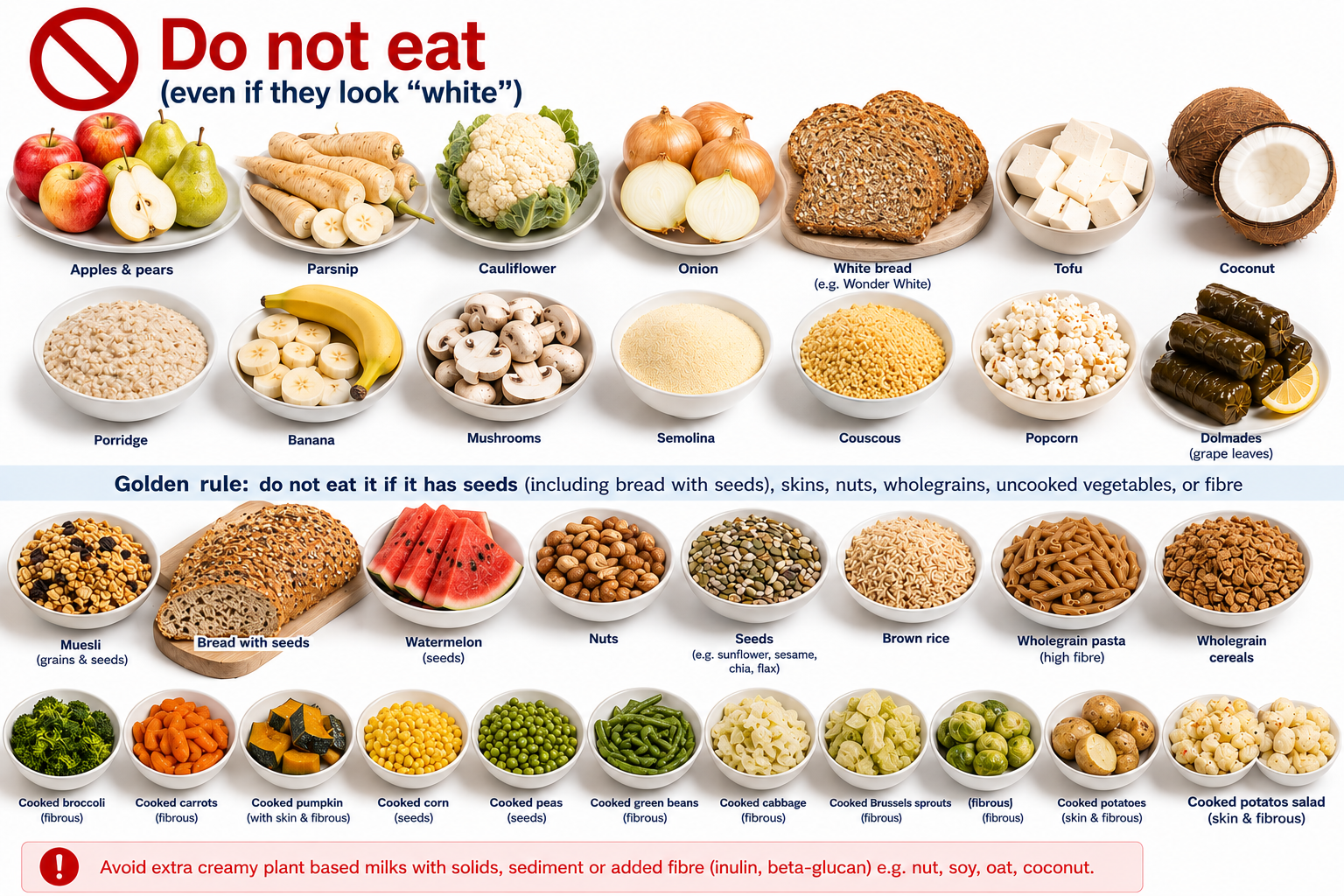
Golden rule: Do not eat nuts, seeds (including bread with seeds), skins, wholegrains or raw, uncooked vegetables.
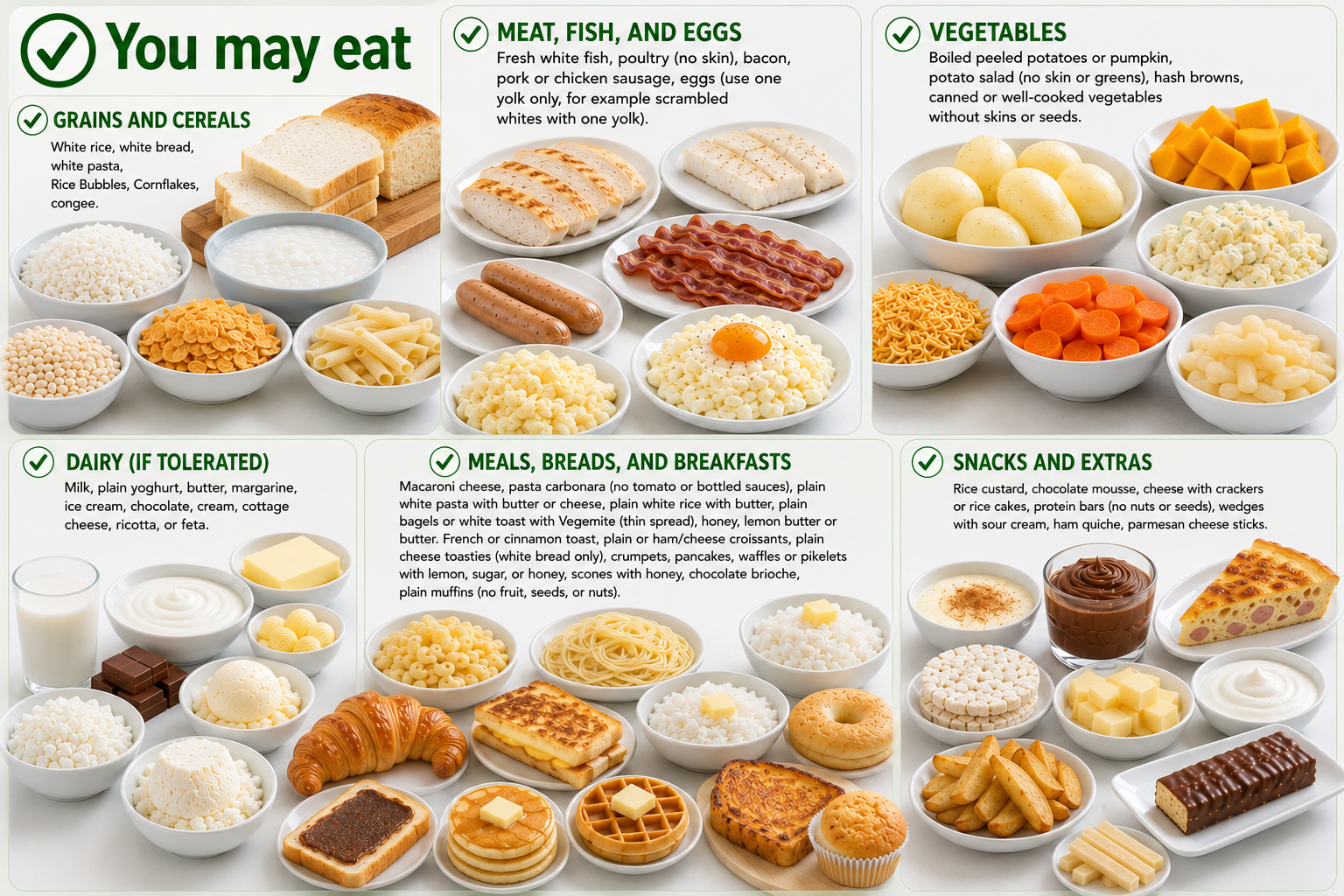


You may eat
Grains and cereals
White rice, white bread, white pasta, Rice Bubbles, Cornflakes, congee.
Meat, fish, and eggs
Fresh white fish, poultry (no skin), bacon, pork or chicken sausage, eggs (use one yolk only, for example scrambled whites with one yolk).
Vegetables
Boiled peeled potatoes or pumpkin, potato salad (no skin or greens), hash browns, canned or well-cooked vegetables without skins or seeds.
Dairy (if tolerated)
Milk, plain yoghurt, butter, margarine, ice cream, chocolate, cream, cottage cheese, ricotta, or feta.
Meals, breads, and breakfasts
Macaroni cheese, pasta carbonara (no tomato or bottled sauces), plain white pasta with butter or cheese, plain white rice with butter, plain bagels or white toast with Vegemite, honey, lemon butter or butter, French or cinnamon toast, plain or ham/cheese croissants, plain cheese toasties (white bread only), crumpets, pancakes, waffles or pikelets with lemon, sugar, or honey, scones with honey, chocolate brioche, plain muffins (no fruit, seeds, or nuts).
Snacks and extras
Rice custard, chocolate mousse, cheese with crackers or rice cakes, protein bars (no nuts or seeds), wedges with sour cream, ham quiche, parmesan cheese sticks.
You may drink
All clear fluids listed in the next section. Some Plant milks - If plain unsweetened, well-filtered except coconut milk and fibre-fortified/seed-based milks
If you usually eat raw fruit or vegetables, you may use a juicing machine to remove the pulp before drinking.
Do not eat
Do not eat (even if they look “white”)
Pears, parsnip, cauliflower, onion, high-fibre white breads (for example Wonder White), tofu, coconut, porridge, banana, mushrooms, semolina, couscous, popcorn. Avoid extra creamy plant based milks with solids, sediment or added fibre (inulin, beta-glucan) eg. nut, soy, oat, coconut.
24-2 hours before your colonoscopy
Clear fluids only (no solid food)
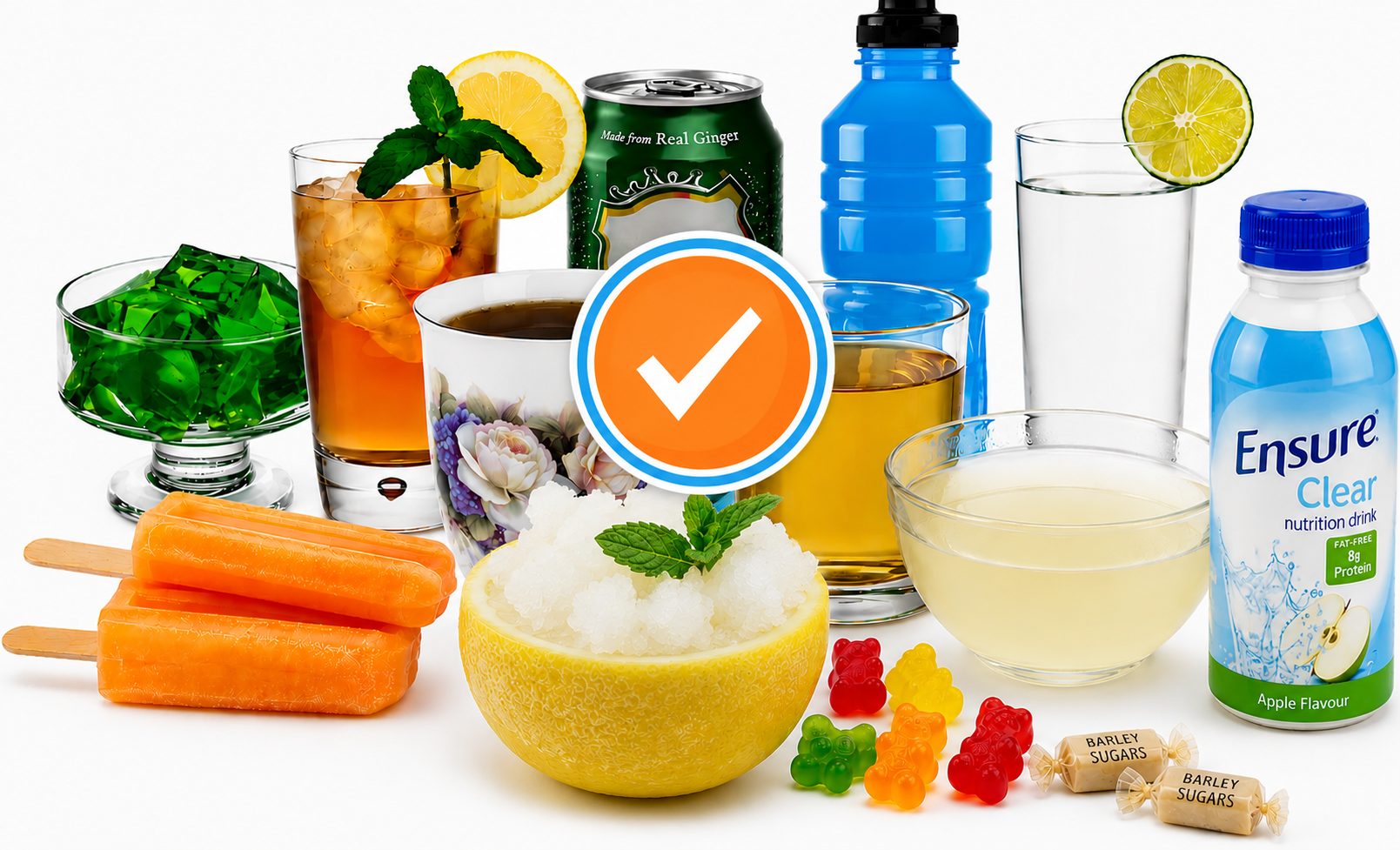
Golden rule: If you can read a newspaper through it, it's allowed.
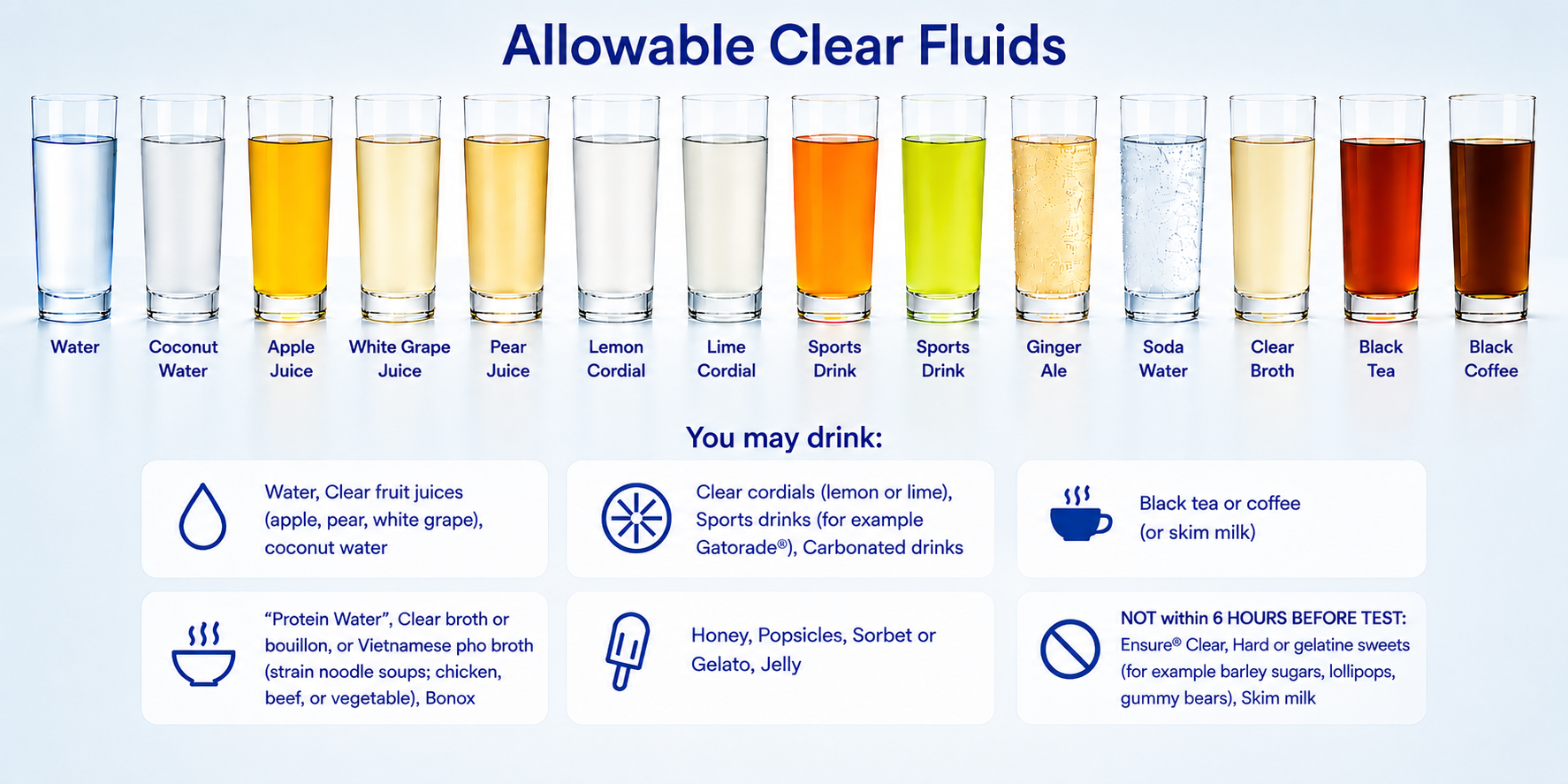 Clear fluid colour guide
Click the image to enlarge
Clear fluid colour guide
Click the image to enlarge
You may drink:
Water, Clear fruit juices (apple, pear, white grape), coconut water
Clear cordials (lemon or lime), Sports drinks or Oral Rehydrate Solutions (eg.Gatorade® or Hydralyte®), Carbonated drinks
Black tea or coffee (or skim milk)
"Protein Water", Clear broth or bouillon, or Vietnamese pho broth (strain noodle soups; chicken, beef, or vegetable), Bonox
Honey, Popsicles, Sorbet or Gelato, Jelly
NOT within 6 HOURS BEFORE TEST:
Ensure® Clear, Skim milk, Hard or gelatine sweets (for example barley sugars, lollipops, gummy bears)
NOT ON TEST DAY:
Very thin congee, Avoid even clear alcohol (light beer, white wine, vodka, gin, or whiskey)
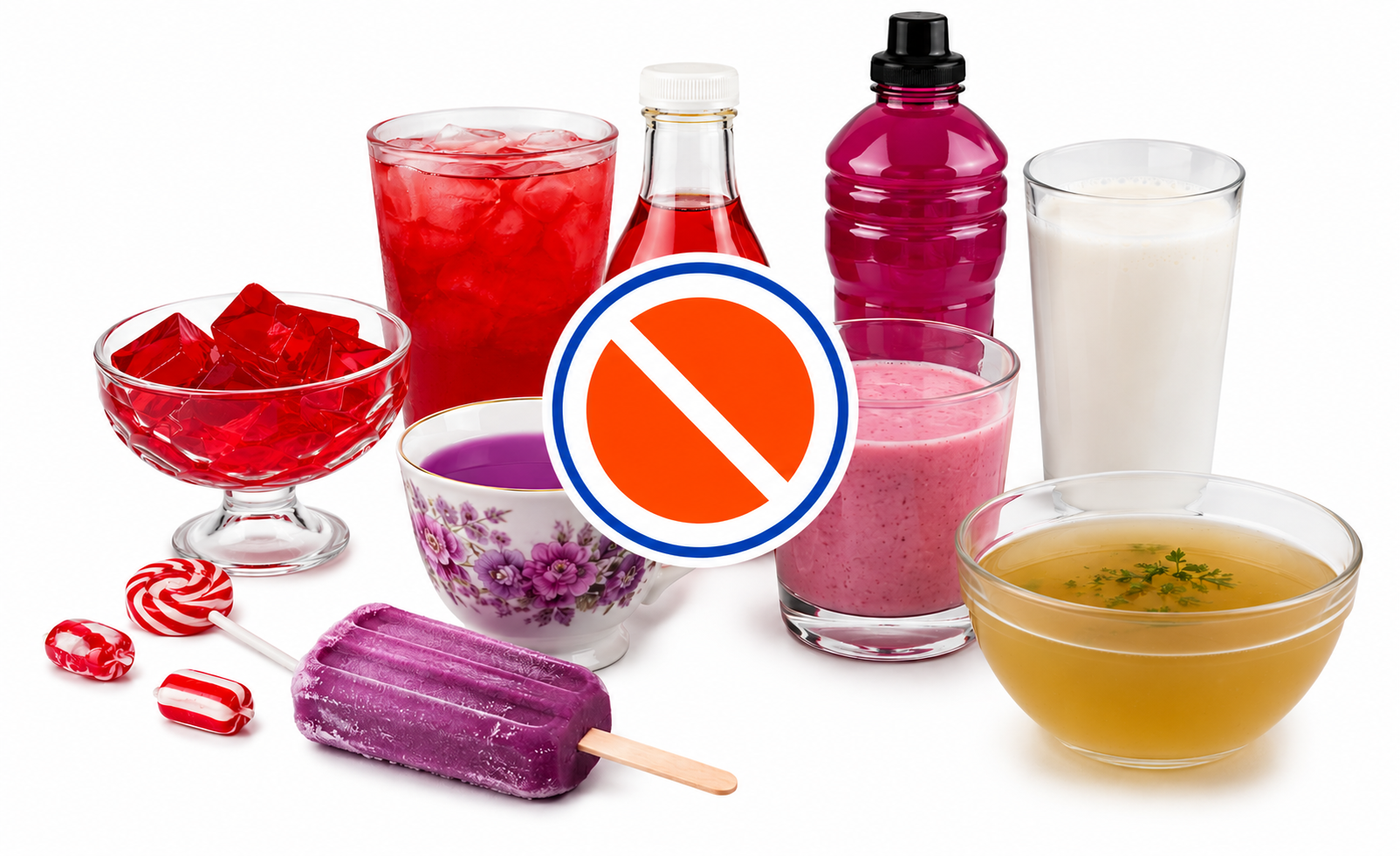
Do not have:
- Any solid food
- Full-cream OR plant-based milk
- Any red, or purple food colouring (for 24 hours before the test) in your fluids
Take care to avoid dehydration.
Aim to drink 2-3 glasses or serves of clear fluids at:
And on the morning of the test, up to 2 hours before your appointment
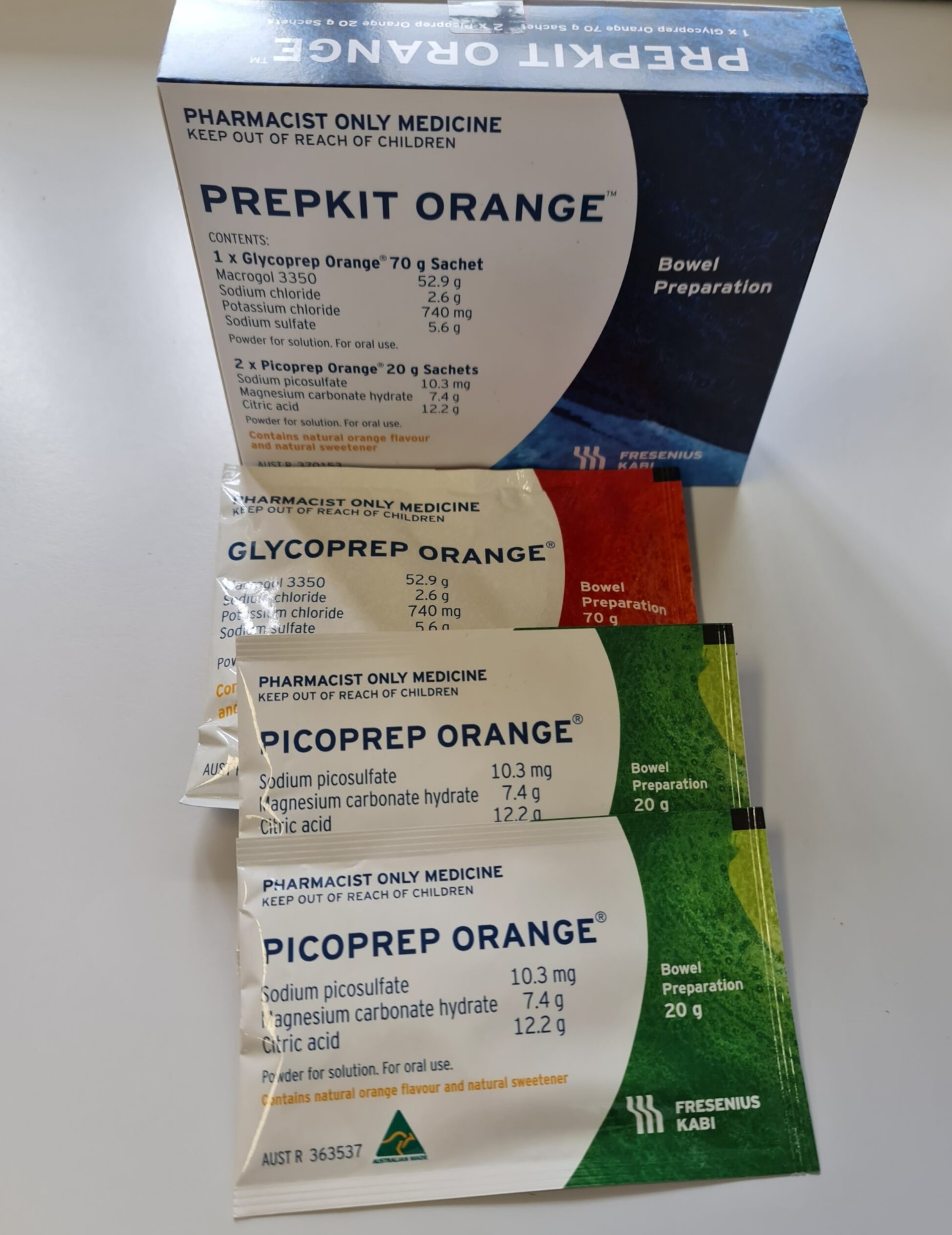
Buy Prepkit Orange (3 sachets) from a local pharmacy before you start the diet.
No prescription required.
Your kit contains:
Picoprep × 2
- Add each sachet to 1 glass (250 mL) of water
- Drink within 30 minutes
Glycoprep × 1
- Add to 1 litre of water
- Drink 1 glass every 15 minutes
Choose your appointment time
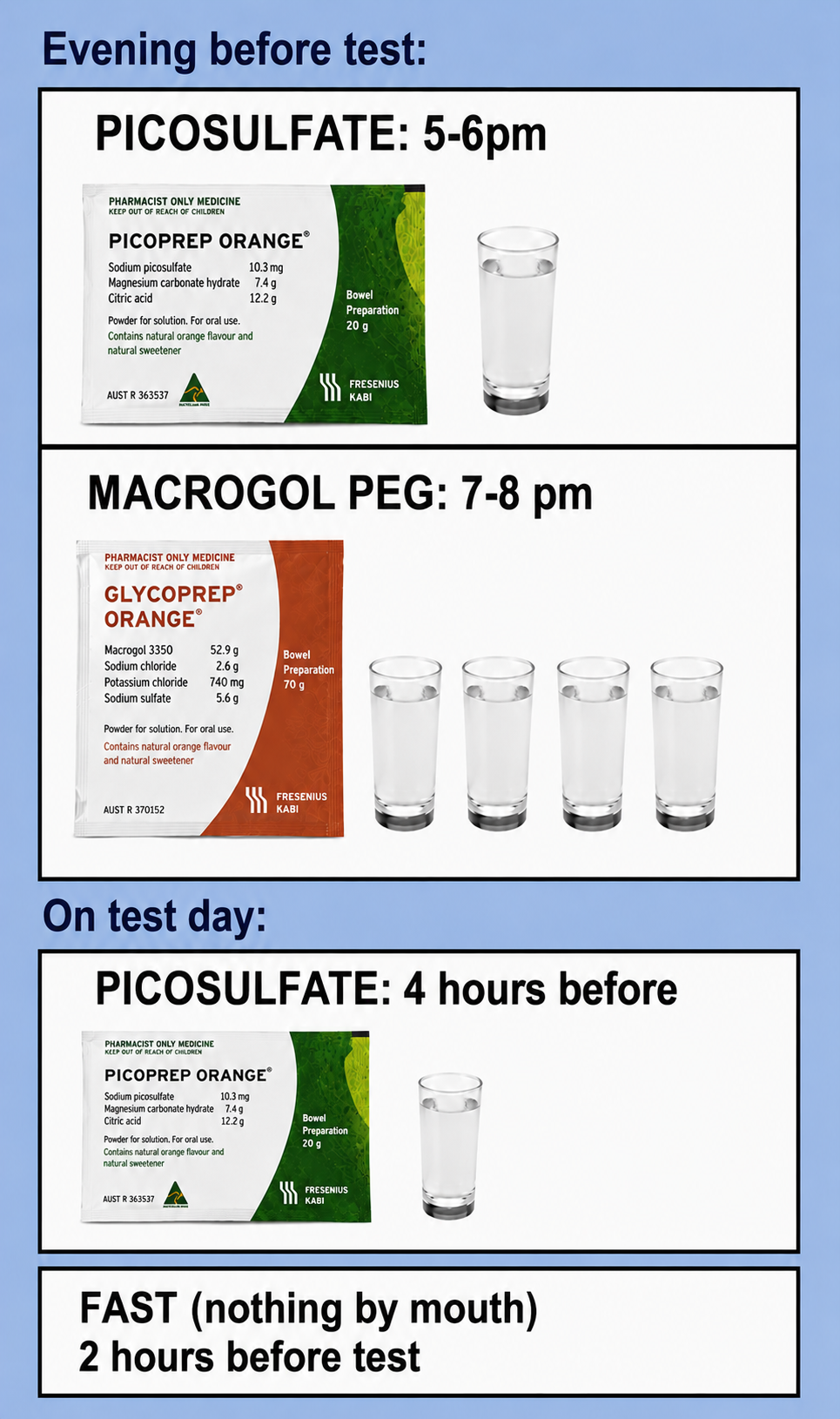
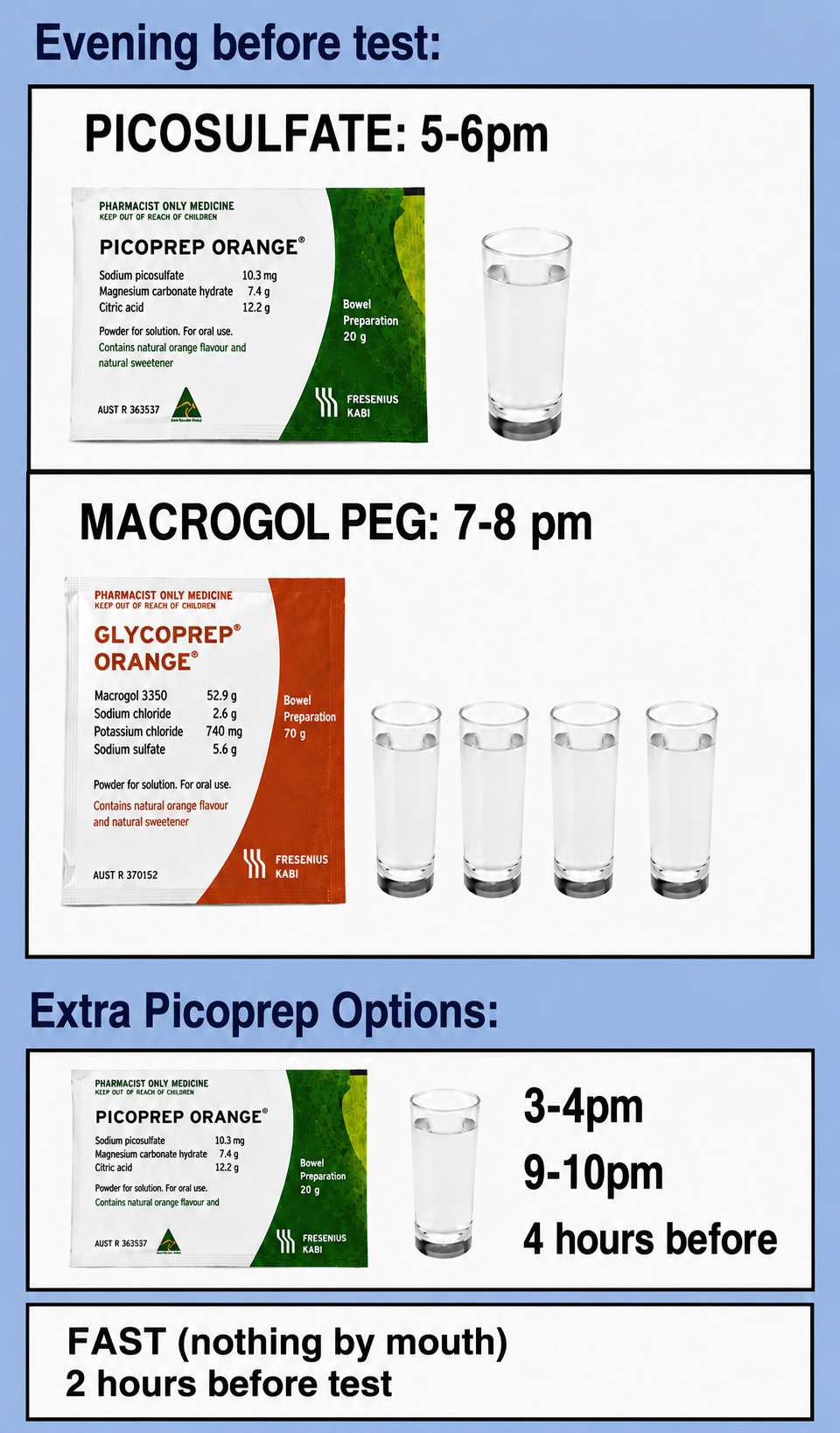
Your three Prepkit Orange sachet timing options
Your options for the third sachet (Picoprep no. 2) depend on when you like to sleep.
Split prep gives the best chance of excellent bowel prep.
However, three sachets taken the day before is usually good enough.
The three options are:
| Option | Sachet 1 | Sachet 2 | Sachet 3 |
|---|---|---|---|
| Most common | 3pm | 5pm | 7pm |
| Later sleeper | 5pm | 7pm | 9pm |
| Best bowel prep alarm required |
5pm | 7pm |
4 hours before
on test day
|
After each sachet, expect diarrhoea to start anywhere from 30 minutes to 4 hours later.
Keep up with clear fluids until 2 hours before your test.
Ten tips for surviving bowel prep
The bowel preparation is usually the hardest part of a colonoscopy. Once it is finished, most patients tell us the procedure itself was easier than they expected.
- Temperature matters. Mix your laxatives in advance. Most people find them easier cold, but some prefer them closer to room temperature or even slightly warm. Try what works for you — the best prep is the one you can actually drink.
- Plan ahead for nausea. If you feel nauseous, slowing down is usually enough. If severe nausea or vomiting is a concern, ask your doctor about ondansetron (Zofran), usually taken one hour before the first laxative dose and then every 6–12 hours if needed.
- Disguise the taste carefully. Lemon juice, lime cordial or ginger ale can help — but only if you never want to drink that again in your life. Suck on boiled lollies, mints or clear jelly sweets between drinks to "reset your mouth".
- Use every trick. Drink through a straw, rinse your mouth afterwards, and adjust the temperature if it helps. It helps more than you would think.
- Stock the freezer and fridge. Peppermint tea, lemonade ice blocks and ginger ale can all be useful during the preparation.
- Protect your skin early. Apply Vaseline or zinc oxide to the anal area before the diarrhoea starts, and use baby wipes instead of toilet paper.
- Make the bathroom safe. Night-time bathroom trips are common. Turn on a light, clear any obstacles and take your time. We would much rather remove polyps than repair broken hips.
- Bring entertainment. Grab a favourite book, download a podcast, charge your phone, or finally start that series everyone keeps recommending. You are about to spend some quality time near the bathroom.
- Keep drinking clear fluids - Not just plain water. Drink clear fluids right up until 2 hours before your procedure, unless you have been told otherwise. Don’t spend 24 hours on water alone — include clear fluids with some salt, sugar/carbohydrate and nourishment. Most patients feel much better when they stay well hydrated.
- We'll assess your preparation. Appearances can mislead. Even if you think your bowel prep hasn't worked, or your bowel motions are still dark or cloudy, please come to your appointment as scheduled. Only the endoscopy team can determine whether your bowel preparation is adequate. What you see in the toilet bowl often does not reflect how clean the bowel is during the procedure.
You are not expected to manage this alone.
If you would be more comfortable being admitted the night before your colonoscopy for extra nursing care, please let our rooms know.
For our Sydney patients, Sister Jenny Burns RN, our North Shore endoscopy practice nurse, will give you her number when she calls before and after your procedure. She is available if you would like to talk about your procedure or bowel preparation. You can also contact the hospital to speak with the endoscopy nurses.
Do any of these apply to you?
Special instructions for some patients only
Most patients can ignore this section and continue with the standard instructions above.
A small number of patients require extra or different bowel preparation. You may be asked to follow the:
A: "Bowel Prep Plus" or "Double Bowel Prep Plus" pathway.
If you have one of these below factors, you are higher risk for poor bowel prep with our standard prep and may need extra bowel prep instruction:
- Previous poor bowel preparation
- Diabetes or Parkinson's disease
- Severe constipation (≤2 motions/week, regular straining, or regular laxative use)
- Diabetes or weight-loss injections such as Ozempic, Wegovy, Mounjaro, Trulicity or similar
- Regular opioid or strong painkiller use
B: MoviPrep pathway.
With the below, you are higher risk for fluid shifts and salt imbalance with standard prep:
Severe kidney disease, liver cirrhosis, or heart failure
Fluid restriction
The standard Prepkit Orange plan may not be safe or suitable for you. You may need a different bowel preparation plan
C: "Colocaps" pathway.
Not able to tolerate liquid bowel preparation
D: ThickenUp pathway
Not able to swallow fluids
The standard Prepkit Orange plan may not be safe or suitable for you. You may need a different bowel preparation plan
Do not follow the standard Prepkit Orange plan until you have confirmed your special instructions with Dr Samuel’s rooms or the endoscopy unit.
To view the relevant instruction guidelines, click the button below.
Still have questions or concerns?
Many patients feel anxious before their first colonoscopy. Most tell us afterwards that the anticipation was worse than the procedure itself. The questions below address some common concerns that may not have been covered elsewhere on this page.
Risks and Safety
Before your procedure starts, Dr Samuel will confirm that you understand the reason for the colonoscopy, the main risks and alternatives, and will answer any questions you have. The endoscopy unit staff will ask you to sign a consent form if this has not already been completed.
Colonoscopy is a very safe procedure. Nausea and bloating are common after taking bowel cleansing laxatives, but these symptoms usually go away quickly.
If the bowel is not clean, or your anatomy makes the test difficult, the doctor may not be able to complete the procedure. In this situation, your doctor may recommend repeating the procedure on another day, arranging another test, or deciding that the limited examination is sufficient.
To maximise your chance of a good bowel preparation, follow the bowel cleansing instructions carefully below. This includes taking the laxatives 4–5 hours before afternoon procedures. Do not following the timing printed in the Prepkit Orange packet insert.
Even with the best techniques, small polyps or tumours can occasionally remain hidden from view and may be missed.
Possible complications
Complications that require urgent surgery are rare (about 1 in 1,000).
In some people, the bowel wall is unexpectedly fragile and can puncture or bleed. Bleeding after polyp removal is usually minor and often stops on its own.
Other uncommon problems include reactions to the sedative or bowel preparation, infections, or worsening of existing heart or lung disease.
You may feel a brief stinging or “sparkle” sensation in your arm from the intravenous sedative. Some people wake with a sore jaw if the anaesthetist needs to apply pressure there to keep your breathing safe during the procedure. This jaw tenderness usually settles after a few days.
Aspiration-related chest infections, which means breathing fluid into the lungs during sedation, are uncommon, particularly if your stomach is empty and you have fasted as instructed.
When to seek medical help
Although complications are uncommon, it is important to recognise them early.
Contact your doctor or hospital if you notice:
-
Severe abdominal pain
-
Dizziness
-
Fever or chills
-
Rectal bleeding (more than half a cup)
-
Severe shortness of breath
Bleeding risk and travel after polyp removal
Your risk of major bleeding after polyp removal continues usually for up to 10–14 days, with the greatest risk in the first 48 hours.
We do not recommend air travel:
-
For domestic flights within 48 hours of polyp removal
-
For long-haul flights or travel to remote areas within 5 days if a polyp has been removed and ideally not for the full 14 days
Are there alternatives to colonoscopy?
Doctors consider colonoscopy the best test to allow both diagnosis and treatment at the same time. Removing "silent" polyps from your colon helps prevent you from getting bowel cancer.
Other tests, such as CT colonography or stool-based tests, may have a role in some situations. You can discuss these options with your doctor to help choose the most appropriate test for you.
What about COVID or recent illness?
If you’ve been unwell recently, we just need to make sure it’s safe for you to go ahead with your colonoscopy and sedation. You can usually continue with your bowel preparation and procedure without delay if:
- Your rapid antigen (RAT) test is negative
- It’s been more than 4 weeks since a mild COVID infection or mild heart or lung illness
- It’s been more than 8 weeks since you were in hospital for a chest infection, breathing, or heart problem
- You are COVID-negative twice – once during bowel prep and again on the day of your procedure
- You have only mild cold or flu symptoms, with a negative PCR (within 3 days) and a negative RAT on the day of your procedure
- You can comfortably climb two flights of stairs while carrying shopping without getting short of breath or chest pain
If you’re unsure, or if any of these don’t apply, please let our staff know. We’ll review your situation and make sure your procedure can go ahead safely.
Procedure Day
On the day of your colonoscopy, the endoscopy team will guide you through each step. The process is usually straightforward, but it helps to know what to expect before you arrive. Most patients spend approximately 2–4 hours in the endoscopy unit from arrival to discharge.
Home → Admission → Consent → Sedation → Colonoscopy → Recovery → Home
After the colonoscopy: recovery and results
When you wake up, you may feel wind pain, bloating, and pass air that was introduced during the test. You may also have some discomfort at the vein access site on your arm.
Even if you feel alert, your judgement, memory, and reflexes will be impaired for the rest of the day.
Your doctor will see you after the test and discuss the results with you, and you will be given a written report. It is common to have little or no memory of the test or this discussion.
Someone you know must drive you home and stay with you after the procedure. Hospital policy does not allow taxi services.
Until the next day, do not:
-
Drive a car
-
Sign legal papers
-
Send important emails
-
Drink alcohol
-
Operate machinery
A report including any biopsy results will be sent to your referring doctor after about one week.
It is important that you contact our rooms to make, and keep, a follow-up appointment with your specialist or referring doctor to discuss your results.

What if something abnormal is found?
If an area needs further testing, a biopsy will be taken. This is a very small sample of the colon lining, about the size of a grain of rice.
If there is any bleeding, it can usually be controlled during the procedure using special techniques.
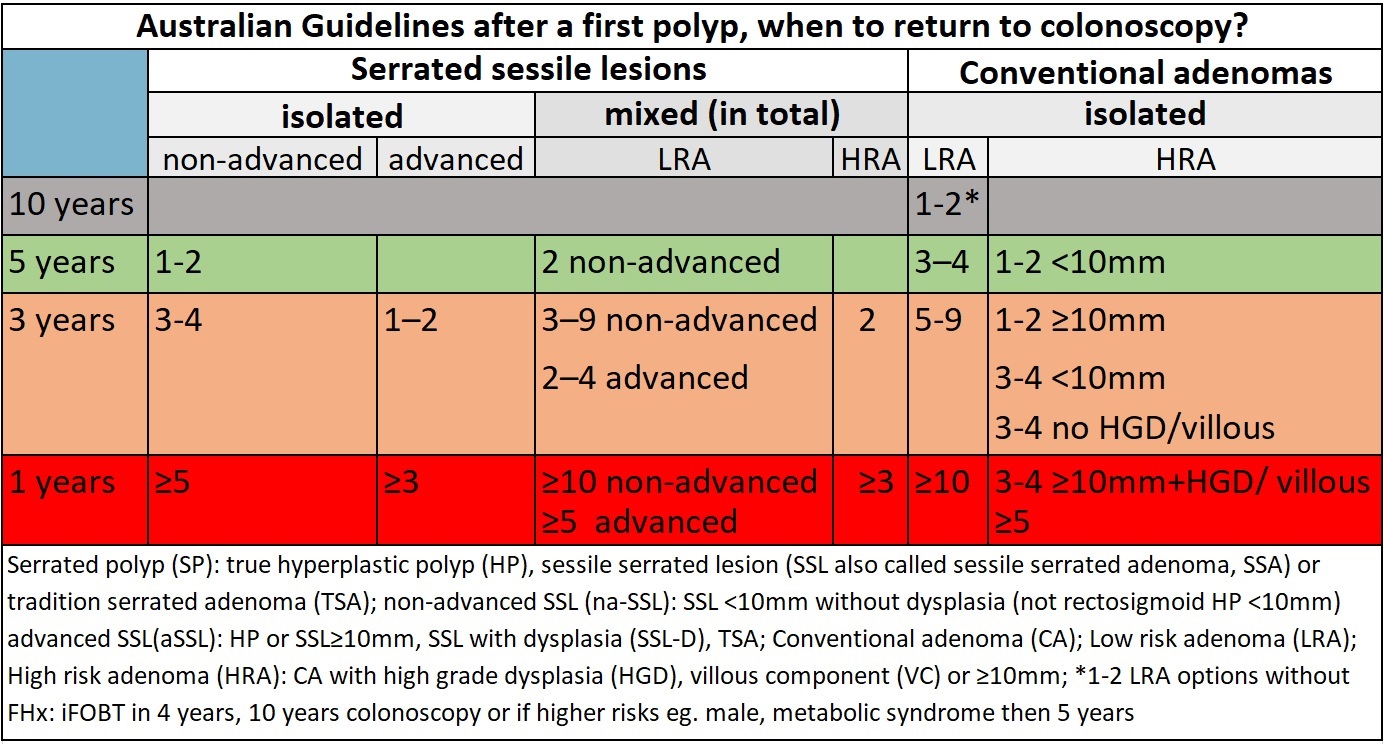
If polyps are found (benign growths on the lining of the colon), they are usually removed at the same time. This is called a polypectomy. Removing polyps is an important way to help prevent bowel cancer.
Biopsies and polyp removal are not painful.
If haemorrhoid bleeding or discomfort is a significant problem, you can ask about treating this during the procedure while you are sedated. Non-surgical options include rubber band ligation or infrared coagulation.
These haemorrhoid treatments usually involve less pain and lower risk than surgery, but they can cause short-term pain or discomfort for a few hours to a few days. You will need to give consent before your sedation if your doctor is going to treat haemorrhoids.